The idea behind the rule
Make the commitment easier to accept.
Facing a whole report can feel daunting. Giving it five minutes is a more limited ask. You can try the work without deciding now how long you will stay.
You are agreeing to five minutes, with permission to stop built in.
That stopping point is part of the agreement from the beginning. You might want to keep going once you've started. You don't have to.
The rule in practice
How it works
Name the smallest first move.
Open the file, not "write the report". If it still feels too big, choose one part of it. Or skip naming it and just start.
Work on it for five minutes.
The timer runs on the clock, so you can leave the app and do the thing. Finishing the task is not required.
Stop, or choose to continue.
When the five minutes are up you are genuinely free to stop. You have kept the agreement either way.
You can stop now.
You started. That's the part that counts.
Small starts leave a trace
Every start counts, even if you stop after forty seconds. There are no streaks to lose, no red days and no notifications asking where you went. A small plant grows a leaf for each finished five minutes and never wilts.
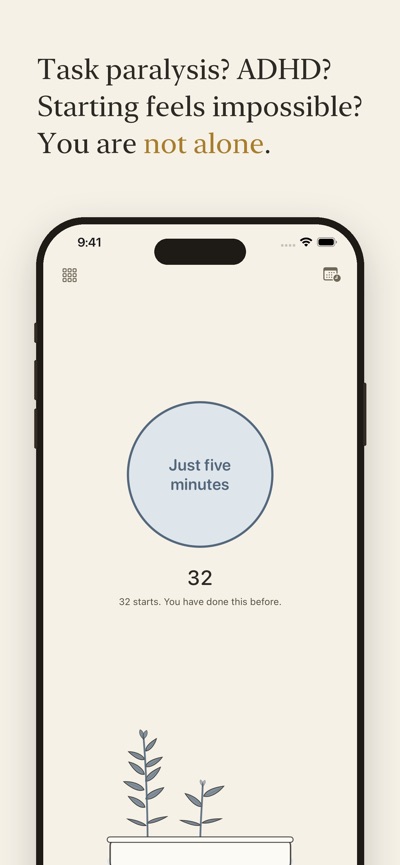
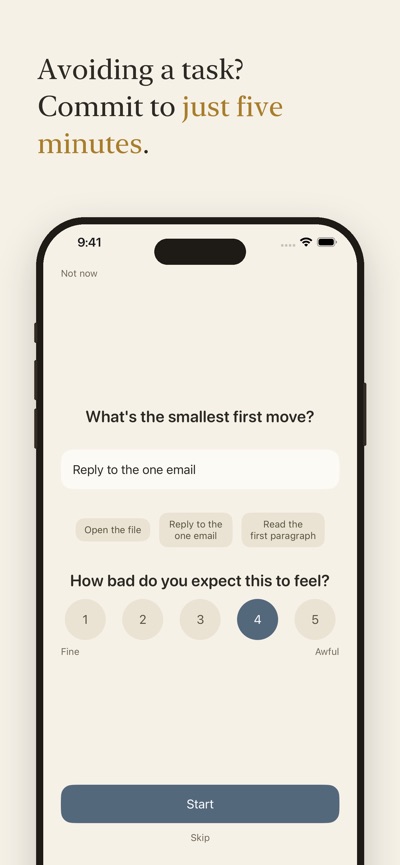
Screens from Five on iPhone.
What Five is not
- Not a to-do list and not a habit tracker with points.
- Not therapy, and not a substitute for it. If you are struggling, talk to a professional.
- Not an account: no sign-up, your record stays on your phone and can be exported at any time.
Guides
Short, sourced explanations of the ideas behind Five.
The five-minute rule: how to start a task you have been avoiding
Commit to five minutes on an avoided task, then let yourself stop. Why it helps, how to do it, and what it can't do.
Task paralysis: when starting feels impossible
Task paralysis is being unable to start something you want or need to do. What it is, why it happens and small things that make starting easier.
ADHD and procrastination: starting without relying on willpower
With ADHD, starting is often the hardest part. Practical ways to make the start smaller and more automatic, without streaks or guilt.
A focus timer for starting, not finishing
Most focus timers help you keep going. If your problem is starting, you need a different kind: short, with a real permission to stop.
Why the dread is often worse than the task
Dread is a prediction about how a task will feel, and predictions about feelings are often off. How to test yours with a simple before-and-after rating.
How to stop procrastinating: what the research says actually helps
Procrastination is mostly about avoiding a feeling, not about time. Seven things that help, from making the start smaller to forgiving yourself for last time.
Body doubling: why working next to someone can help you start
Body doubling means doing a task while someone else is there, in person or on a call. What it is, why it may help, what the evidence says, and how to try it.
Pomodoro not working for you? Six alternatives, matched to the problem
Pomodoro suits some people, not others. What the research says, and six alternatives for when starting, focus or breaks are the hard part.
Starting homework with ADHD: practical steps for students and parents
Why homework is so hard to start with ADHD, and what helps: a written plan, a tiny first step, a fixed time and place, and support that builds structure.
How to start studying when you don't feel like it
You don't need motivation to start studying; it often arrives after you start. A small start, a set time, and the study methods that work best.
How to reply to an email you've been avoiding
An avoided email gets heavier every day. How to break the loop: open it, write the shortest useful reply, apologise once, and send. With templates.
How to start tidying a room when the mess feels overwhelming
A messy room isn't one task but hundreds of small decisions. Start with one small area, one kind of thing, and five minutes. Here's how.
Why Five exists
I wanted to make this app because the five-minute rule has helped me so much. Giving myself permission to stop after five minutes has changed how the whole thing feels.
— the person who made Five

Put the rule into practice
Meet Five.
Name the smallest first move, start five minutes, and stop when the time is up if you want to. Five counts every start and never keeps a streak.
For iPhone. New subscribers get one week free, everything included; then a monthly or yearly subscription, with the price shown in your currency before you subscribe. No account needed.
Questions
What if I stop after five minutes?
You have done what you agreed to. You can stop there or choose another five minutes. The rule does not depend on you carrying on.
Does finding it hard to start mean I have ADHD?
No. Difficulty starting a task does not establish a diagnosis. Five is a timer app and does not diagnose or treat ADHD.
Sources & context
- The five-minute rule · Cognitive Behavioral Therapy Los Angeles
- De-procrastination · Oxford Health NHS
- ADHD: what you need to know · NIMH
Five minutes is a practical convention, not a proven clinical threshold. Five is not a treatment for ADHD.